
Clearwater Water Quality: Three Plants, Three Different Answers (2026)

Updated: Sep 10

Two of the three water treatment plants the City of Clearwater runs are reverse osmosis plants, and the city's own 2025 water quality report says they pull out hardness-causing salts before the water ever reaches your street. That single fact explains most of what people find confusing about Clearwater water quality: the answer genuinely changes depending on which plant feeds your house.
Quick summary: The City of Clearwater does not publish a hardness number anywhere in its 2025 water quality report, but Pinellas County Utilities, which supplies the rest of Clearwater's water, publishes 217 parts per million, or 11.1 to 14.3 grains per gallon. Clearwater runs three water treatment plants and two of them use reverse osmosis, which removes hardness-causing salts. The third plant blends raw Floridan Aquifer water with purchased Pinellas County water and does no softening at all. All three plants disinfect with monochloramines. The only way to know your own number is to test at your own tap.
Clearwater water at a glance, 2025 reporting year
What | The number | Where it comes from |
Water source | About 60 percent city wells, rest bought from Pinellas County | City of Clearwater 2025 report |
Aquifer | Floridan Aquifer | City of Clearwater 2025 report |
Treatment plants | 3 total, 2 using reverse osmosis | City of Clearwater 2025 report |
Disinfectant | Monochloramines, 3.18 ppm against a 4.0 limit | City of Clearwater 2025 report |
Hardness in the city report | Not published anywhere in it | City of Clearwater 2025 report |
Hardness in the county supply | 217 ppm, 11.1 to 14.3 grains per gallon | Pinellas County Utilities 2025 report |
Fluoride | Discontinued during 2025 | City of Clearwater |
Bottom line: Clearwater is one of the few Tampa Bay cities already doing part of the softening job for you, and one of the few that publishes no hardness number at all.
Where does Clearwater's water actually come from?
About 60 percent of Clearwater's drinking water is pumped from city-owned wells in the Floridan Aquifer, and the rest is bought from Pinellas County Utilities. The City of Clearwater's 2025 annual water quality report puts total daily use at roughly 11 million gallons. Pinellas County Utilities in turn buys its water from Tampa Bay Water.
Here is the part almost everyone gets wrong, and I include water companies in that. The City of Clearwater is not a Tampa Bay Water member government. Tampa Bay Water has six member governments: Hillsborough County, Pasco County, Pinellas County, New Port Richey, St. Petersburg and Tampa. Clearwater receives regional water second hand, as a wholesale customer of Pinellas County Utilities.
The confusion is fair, because Tampa Bay Water's headquarters sits physically inside Clearwater. But the distinction matters the moment you go looking for numbers, because it tells you which report to open. You can read the City of Clearwater annual water quality report yourself. The same city-versus-county split shows up in our St. Petersburg water guide, where the city runs its own utility and does publish a hardness figure.
Why do two of Clearwater's three water plants use reverse osmosis?
Two of Clearwater's three water treatment plants use reverse osmosis because the deeper groundwater under Clearwater is brackish. The City of Clearwater's 2025 water quality report states that Reverse Osmosis Plant No. 2 treats brackish water drawn from the lower portions of the Upper Floridan Aquifer, and that both reverse osmosis plants remove hardness-causing salts.
This was not a small municipal upgrade. The Southwest Florida Water Management District, which contributed nearly 15 million dollars toward the 34 million dollar project, describes Clearwater's second reverse osmosis plant as a brackish water plant with its own brackish wellfield and a concentrate disposal well, producing more than 5 million gallons a day. It opened in 2015.
The reason sits in the city's own words on its reverse osmosis page: increased mineralization has forced the abandonment of certain wells over time. Coastal Pinellas County groundwater gets saltier the deeper you draw it, so rather than walk away from a well field the city has used since the 1920s, the City of Clearwater built treatment to match the water it has.
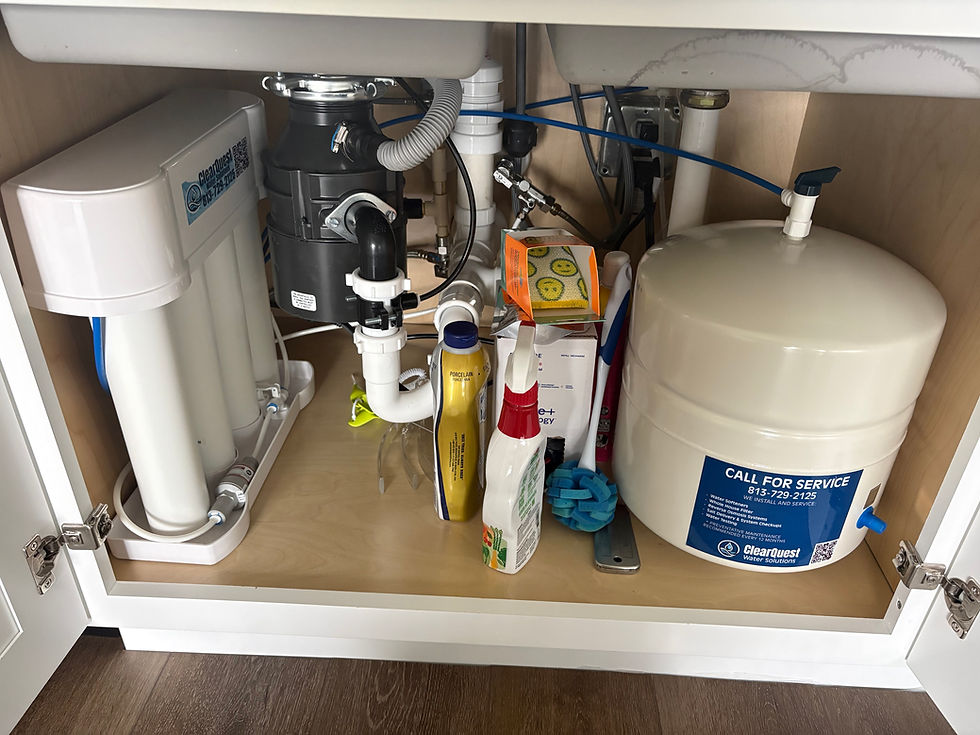
It is the same technology as an under-sink reverse osmosis system, running at municipal scale. Water Treatment Plant No. 3 does none of that. It blends raw Floridan Aquifer water with Pinellas County water, adds monochloramine and sends it out.
How hard is Clearwater's water?
The City of Clearwater publishes no hardness number at all. I read the 2025 annual water quality report end to end and there is no total hardness row, no calcium row and no magnesium row anywhere in it. The word hardness appears exactly twice, both times describing what the two reverse osmosis plants remove.
Pinellas County Utilities does publish one, and because Pinellas County water makes up roughly 40 percent of Clearwater's supply, that is the honest figure to work from. The Pinellas County consumer confidence reports list total hardness at 217 parts per million for 2025, ranging from 189 to 244, and state the water softener setting equivalent as 11.1 to 14.3 grains per gallon.
The Papadakis family in Countryside had already been handed a number before we ever knocked, and it was wrong. A door-to-door salesperson told them their water ran 22 grains per gallon and quoted a system on the doorstep. That figure appears in no document the City of Clearwater or Pinellas County Utilities publishes. When we tested at their kitchen tap the reading landed inside the range Pinellas County Utilities reports, nowhere near 22.
Retailer pages quoting Clearwater hardness at 17 to 22 grains per gallon are not citing the city or the county, because neither publishes anything close. A number pulled off a website is not your number anyway. For a nearby contrast, our New Port Richey water guide covers a city split between municipal supply and private coastal wells, and our Clearwater water treatment page covers what we install here.

What does the Clearwater water quality report say about safety?
The City of Clearwater reported no maximum contaminant level violations for 2025, and every regulated row in the report is marked as no violation. Lead came back at a 90th percentile of 1.2 parts per billion against an action level of 15. Copper came back at 0.34 parts per million against an action level of 1.3.
Two numbers are worth watching rather than worrying about. Total trihalomethanes measured 68.0 parts per billion against a legal limit of 80, the closest to a limit anything in the Clearwater water quality report gets. Haloacetic acids measured 32.5 against a limit of 60. Both are disinfection by-products, the trade-off that comes with treating water so it is still safe when it reaches you.
Fluoride is the change most people have not registered yet. The City of Clearwater stopped adding fluoride during 2025 to comply with the new state law. Reverse Osmosis Plant No. 1 depleted its supply on May 30, 2025 and Reverse Osmosis Plant No. 2 on June 13, 2025. Water Treatment Plant No. 3 never fluoridated, because it already received fluoridated water from Pinellas County Utilities.
Why does Clearwater water sometimes taste or smell like a pool?
All three City of Clearwater plants disinfect with monochloramines, and monochloramine is what most people are tasting when Clearwater water tastes like a swimming pool. The city's 2025 report lists a running annual average of 3.18 parts per million against a maximum residual disinfectant level of 4.0, with individual samples ranging from 0.6 to 4.9.
Monochloramine is chlorine combined with ammonia. It holds a disinfectant residual far longer than free chlorine does across miles of pipe, which is why utilities across Tampa Bay use it, and it is also more stubborn to remove at the tap. A sediment filter will not touch monochloramine and a basic carbon pitcher struggles with it.
Catalytic carbon is the media that actually handles monochloramine. If you keep fish, or anyone in the house is on kidney dialysis, monochloramine has to be removed before use exactly as chlorine does.

What actually fixes hard water and chloramine taste in Clearwater?
For most Clearwater homes the answer is a water softener paired with carbon filtration, plus a reverse osmosis system at the kitchen sink if drinking water taste is the real complaint. Which of those you need depends on your reading, not your zip code, because the City of Clearwater's own treatment already varies from plant to plant.
What each fix actually does
The fix | What it handles | What it does not |
Water softener | Calcium and magnesium hardness, scale, spotting | Chloramine taste or odor |
Carbon filtration | Monochloramine taste and odor | Hardness or scale |
Dual-media system | Hardness and monochloramine in one tank | Dissolved solids at the drinking tap |
Reverse osmosis | Taste and a broad contaminant range at one tap | Scale in the water heater or shower |
Bottom line: A water softener and a carbon filter solve different problems, and buying one while expecting the other is the most common mistake I see in Clearwater.
Our dual-media city water treatment systems put softening and carbon filtration in one tank, which is usually the cleanest answer on chloraminated city water. If your address is fed by Water Treatment Plant No. 3 you are taking untreated hardness from two directions at once, and that is where a softener pays for itself fastest. If a reverse osmosis plant feeds you, you may need less capacity than a salesperson assumes.

How do you find out which Clearwater plant serves your address?
There is no public map showing which of the three City of Clearwater plants serves a given address, and the city does not publish one. The practical answer is to stop hunting for it and test at your own tap, because the reading at the tap already includes whatever blending happened upstream.
You can still narrow it down. If your water bill comes from Pinellas County Utilities rather than the City of Clearwater, you are on county water and the county's published 217 parts per million is your starting point. If you bill through the city, your hardness could land anywhere between low and that county figure.
That uncertainty is exactly why a reading beats an average. A hardness test takes about a minute, and monochloramine, iron, pH and total dissolved solids take a few more. You can see the full list of areas we cover or read our other Tampa Bay water guides first.
After nine of these Tampa Bay city guides, Clearwater is the first one whose utility already owns reverse osmosis equipment and already takes hardness out on your behalf. That is worth knowing before anyone tells you the city is doing nothing about your water.
Frequently asked questions
Is Clearwater tap water safe to drink?
The City of Clearwater reported no maximum contaminant level violations in its 2025 annual water quality report, and every regulated result in that report is marked as no violation. Lead measured 1.2 parts per billion at the 90th percentile against an action level of 15 parts per billion. Hardness, taste and scale are aesthetic issues that sit separately from safety.
How hard is the water in Clearwater, Florida?
The City of Clearwater does not publish a hardness number in its water quality report. Pinellas County Utilities, which supplies roughly 40 percent of Clearwater's water, publishes total hardness of 217 parts per million for 2025, equivalent to 11.1 to 14.3 grains per gallon. Because two of Clearwater's three plants use reverse osmosis, hardness at a specific Clearwater tap can be lower than that.
Does Clearwater use chlorine or chloramine?
All three City of Clearwater water treatment plants disinfect with monochloramines. The city's 2025 report lists a running annual average of 3.18 parts per million against a maximum residual disinfectant level of 4.0 parts per million. Removing monochloramine at the tap takes catalytic carbon rather than a basic sediment or carbon filter.
Does Clearwater still add fluoride to the water?
The City of Clearwater discontinued adding fluoride during 2025 to comply with the new Florida law. Reverse Osmosis Plant No. 1 depleted its supply on May 30, 2025 and Reverse Osmosis Plant No. 2 on June 13, 2025. Water Treatment Plant No. 3 never fluoridated, because it received already fluoridated water from Pinellas County Utilities.
Do Clearwater homes need a water softener?
Most Clearwater homes on the blended supply benefit from a water softener, and homes fed by the two reverse osmosis plants often need less capacity than a salesperson assumes. The only way to size one correctly is a hardness reading at your own tap. Sizing off a published city average is how systems end up oversized in Clearwater.
Is Clearwater part of Tampa Bay Water?
The City of Clearwater is not a Tampa Bay Water member government. Tampa Bay Water's six member governments are Hillsborough County, Pasco County, Pinellas County, New Port Richey, St. Petersburg and Tampa. Clearwater receives regional Tampa Bay Water supply indirectly, as a wholesale customer of Pinellas County Utilities.
What should you do next about your Clearwater water?
Start with the free test. You cannot size a softener or choose a carbon media off a city average, and in Clearwater there is not even a city average to work from. Our free in-home water test reads hardness, monochloramine, iron, pH and total dissolved solids at your own tap, takes about 45 to 60 minutes, and the results get explained on the spot.
Dual-Media City Water Treatment. Best for Clearwater homes fighting hardness and monochloramine taste at the same time, which is most homes fed by the blending plant.
Reverse Osmosis Drinking Water. Best when the complaint is taste, ice, coffee or a bottled water habit rather than scale on the fixtures.
Service and Repair. Best if you inherited a softener with the house. On chloraminated Clearwater water a rebed or a valve rebuild often beats a replacement, and we will tell you when that is the case.
Call or text (813) 729-2125, or book your free water test online. No pressure, no obligation - just answers.
Zach Brownell, ClearQuest Water Solutions - 10+ years installing and servicing water systems across Tampa Bay.
Last updated September 2026


Comments