
Fridge Water Tastes Bad? Why the Built-In Filter Is Not Enough (2026)

Updated: Aug 22

Your refrigerator filter is probably working exactly as designed. That is the part nobody tells you. If the water still tastes bad after a fresh cartridge, the filter is not broken and you did not buy a bad one. It was never built to remove the thing you are tasting.
Quick summary: Refrigerator water tastes bad most often because a fridge carbon filter is built to fix taste and smell, not the dissolved minerals behind a flat or metallic taste. The CDC states that the main purpose of the carbon filters built into refrigerators is to improve taste and smell rather than safety. Most are certified to NSF/ANSI 42, the aesthetic standard, so chlorine goes and dissolved solids stay. If a fresh cartridge does not fix the taste, you are dealing with either a spent filter or something carbon cannot catch. Reverse osmosis is the step that removes dissolved solids.
What your refrigerator filter can and cannot fix
What you taste | Fridge carbon filter? | What actually fixes it |
Chlorine or pool taste | Yes, with a fresh cartridge | The cartridge, replaced on schedule |
Flat, salty or mineral taste | No | Reverse osmosis |
Metallic taste | No | A water test first |
Stale or musty taste | No | The fridge water line, not the filter |
Bottom line: A refrigerator filter is an aesthetic filter. If what bothers you is not an aesthetic problem, no cartridge will fix it.
Why does my refrigerator water taste bad?
Because the filter behind the door does a narrower job than most people assume. A refrigerator filter is an activated carbon cartridge, and carbon is very good at chlorine, taste and odor and close to useless against dissolved minerals. If your water tastes flat, salty or heavy, those minerals went straight through.
This is the most common misunderstanding we hear on drinking water calls. People assume filtered means stripped down to pure water. Filtered means one specific set of things was reduced, and everything outside that set arrived at the glass untouched. If your worry is safety rather than taste, whether Tampa tap water is safe to drink covers that separately.
What does a fridge carbon filter actually remove?
Chlorine, taste and odor, and not much beyond that unless the cartridge says otherwise. The CDC puts it plainly: the main purpose of the carbon filters built into refrigerators is to improve the taste and smell of water rather than its safety. That is a real benefit, and it is also the whole benefit.
The certification tells you the rest. According to NSF, NSF/ANSI 42 certifies a filter for reducing aesthetic impurities such as chlorine, taste and odor, while NSF/ANSI 53 certifies reduction of a contaminant with a health effect as regulated by the Environmental Protection Agency. Many refrigerator cartridges carry 42 only.
So the number stamped on the cartridge is the honest spec sheet. A cartridge certified to NSF/ANSI 42 was never tested to reduce lead, and reading that number takes ten seconds.
Why does the taste come back before the filter is due?
Usually because the cartridge hit its capacity before it hit its date. Activated carbon works until its surface is loaded, and how fast that happens depends on how much chlorine is in your water and how much water your household runs through the door, not on the calendar printed in the manual.
The indicator light is a timer or a volume counter, not a sensor. It has no idea what your water is like. A busy household on heavily chlorinated water can exhaust a cartridge well before the light changes, which is why the taste creeps back and people conclude the filter is defective.

Is reverse osmosis actually different, or just more expensive?
It is genuinely different, because it removes a category of things carbon cannot. Reverse osmosis pushes water through a semi-permeable membrane, so it takes out dissolved solids rather than adsorbing chemicals. That is the difference between improving how water tastes and changing what is dissolved in it.
The CDC lists reverse osmosis as removing germs and some chemicals including lead, copper, chromium, chloride and sodium, and notes it may also reduce arsenic, fluoride, radium, sulfate, calcium, magnesium, potassium and nitrate. NSF/ANSI 58 is the standard written specifically for reverse osmosis, and it includes test procedures for total dissolved solids reduction.
Refrigerator filter versus reverse osmosis
What it handles | Fridge carbon filter | Reverse osmosis |
Chlorine taste and odor | Yes | Yes |
Dissolved minerals | No | Yes |
Lead | Only if certified to 53 | Yes |
Certification standard | NSF/ANSI 42 or 53 | NSF/ANSI 58 |
Where it serves | One dispenser | A dedicated drinking tap |
That is not an argument that everyone needs reverse osmosis drinking water. It is an argument for matching the tool to the complaint. If chlorine taste is the whole problem, a fresh cartridge on schedule is the cheaper right answer, and we will say so. If you want the numbers first, what reverse osmosis costs in Tampa Bay covers the market ranges.
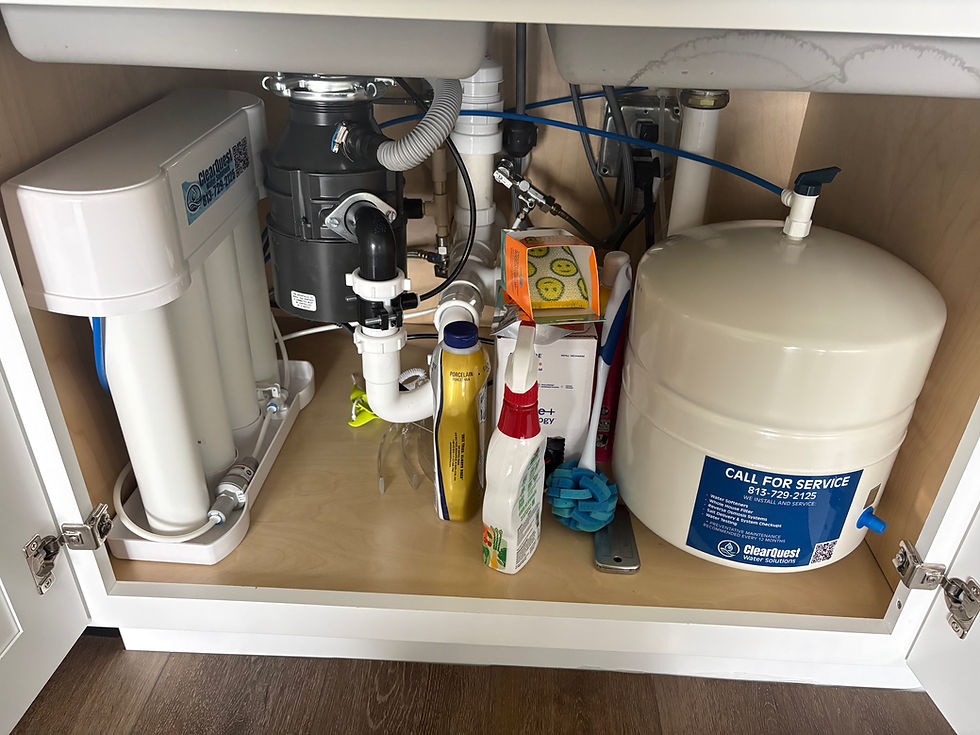
Does Hillsborough County water make this worse in Brandon?
Not worse, but more variable than people expect. Hillsborough County Water Resources operates 11 separate community public drinking water systems, each with its own annual water quality report published every June. There is no single Hillsborough County water, which is why two neighbors a few miles apart can have genuinely different experiences with the same refrigerator.
That matters for taste specifically. If your system runs a chlorine conversion, the taste change shows up at the fridge door first and a carbon cartridge handles it, which is covered in why your water suddenly smells like a pool. If the complaint is a steady mineral heaviness that never lifts, that is dissolved solids and no cartridge is going to touch it. Most water treatment in Brandon starts by telling those two apart.
How do you tell which problem you have?
Compare the fridge water against the kitchen tap, cold, in two clean glasses. If the fridge water is clearly better but still not right, the cartridge is working and something outside its range is left. If they taste the same, the cartridge is spent or seated wrong.
The Tran family in Brandon ran this exact test after getting tired of the problem. They had bought a refrigerator specifically for the filtered water, replaced the cartridge twice at full retail price, and were ready to write off filters entirely. Both glasses tasted identical, which told them the cartridge was not the variable.
A test at the kitchen sink found dissolved solids high enough to explain the flat taste. The honest recommendation was that no cartridge would fix it, and that the fridge filter should stay for chlorine while a separate drinking water system handled the rest. They had assumed they were buying bad filters. They were buying the wrong tool. There is more on drinking water and reverse osmosis if you are working through the same thing.
Frequently asked questions
Why does my refrigerator water taste bad even with a new filter?
A new cartridge only helps if the taste is something carbon can remove. According to the CDC, the main purpose of the carbon filters built into refrigerators is to improve taste and smell rather than safety. If the water tastes flat, salty or mineral heavy, that is dissolved solids passing straight through, and no replacement cartridge will change it.
How often should I replace my refrigerator water filter?
Follow the interval printed in your refrigerator manual, which manufacturers set by months or by gallons rather than by taste. Waiting until the water tastes bad means the cartridge has been spent for a while. A carbon filter that is past its capacity can stop reducing chlorine taste well before the indicator light changes.
Does a refrigerator filter remove hard water minerals?
A refrigerator filter does not remove hard water minerals. Calcium and magnesium are dissolved solids, and activated carbon works by adsorbing chemicals rather than by removing dissolved minerals. That is why softened or filtered fridge water can still leave spots and still taste mineral heavy in Tampa Bay homes.
Is reverse osmosis better than a refrigerator water filter?
Reverse osmosis and a refrigerator filter are certified against different standards because they do different jobs. NSF/ANSI 42 covers aesthetic reduction such as chlorine, taste and odor, while NSF/ANSI 58 covers reverse osmosis and includes total dissolved solids reduction. For a taste problem carbon cannot touch, reverse osmosis is the step that actually changes the water.
Can a refrigerator filter remove lead?
Only a filter certified to NSF/ANSI 53 for lead is tested to reduce it, and many refrigerator filters are certified to NSF/ANSI 42 for aesthetic reduction only. Check the certification on the cartridge rather than assuming. The CDC recommends testing your water first and then choosing a filter that removes what you are actually concerned about.
Does Brandon city water need extra filtering for taste?
It depends on which system serves your address. Hillsborough County Water Resources operates 11 separate community drinking water systems, each publishing its own annual report, so water quality in Brandon is not identical across the county. Read the report for your system, then decide whether the taste you are chasing is a chlorine issue or a dissolved solids issue.
Not sure whether it is the filter or the water?
Start with the free test. We measure what is actually in your water at your kitchen sink and tell you plainly whether a cartridge can fix it. Book a free in-home water test, and if the answer is just replace your fridge filter on schedule, that is what we will tell you.
Reverse Osmosis Drinking Water - the fix when the taste is dissolved solids rather than chlorine. It feeds a dedicated tap for drinking, cooking, ice and coffee, and it is sized to what your test actually finds.
Dual-Media City Water Treatment - worth considering if the taste complaint arrives alongside hardness and chlorine across the whole house rather than at one dispenser.
Call or text (813) 729-2125, or book your free water test online. No pressure, no obligation - just answers.
Zach Brownell, ClearQuest Water Solutions - 10+ years installing and servicing water systems across Tampa Bay.
Last updated August 2026


Comments